The Heat Tax
How extreme heat quietly extracts income from the workers who can least afford to lose it
In 2024, India lost 247 billion labour hours to extreme heat equivalent to $194 billion in potential income. No court ordered it. No legislature passed it. It was simply extracted, silently and regressively, by a warming climate from the people who contributed least to the problem and received no compensation for the loss.
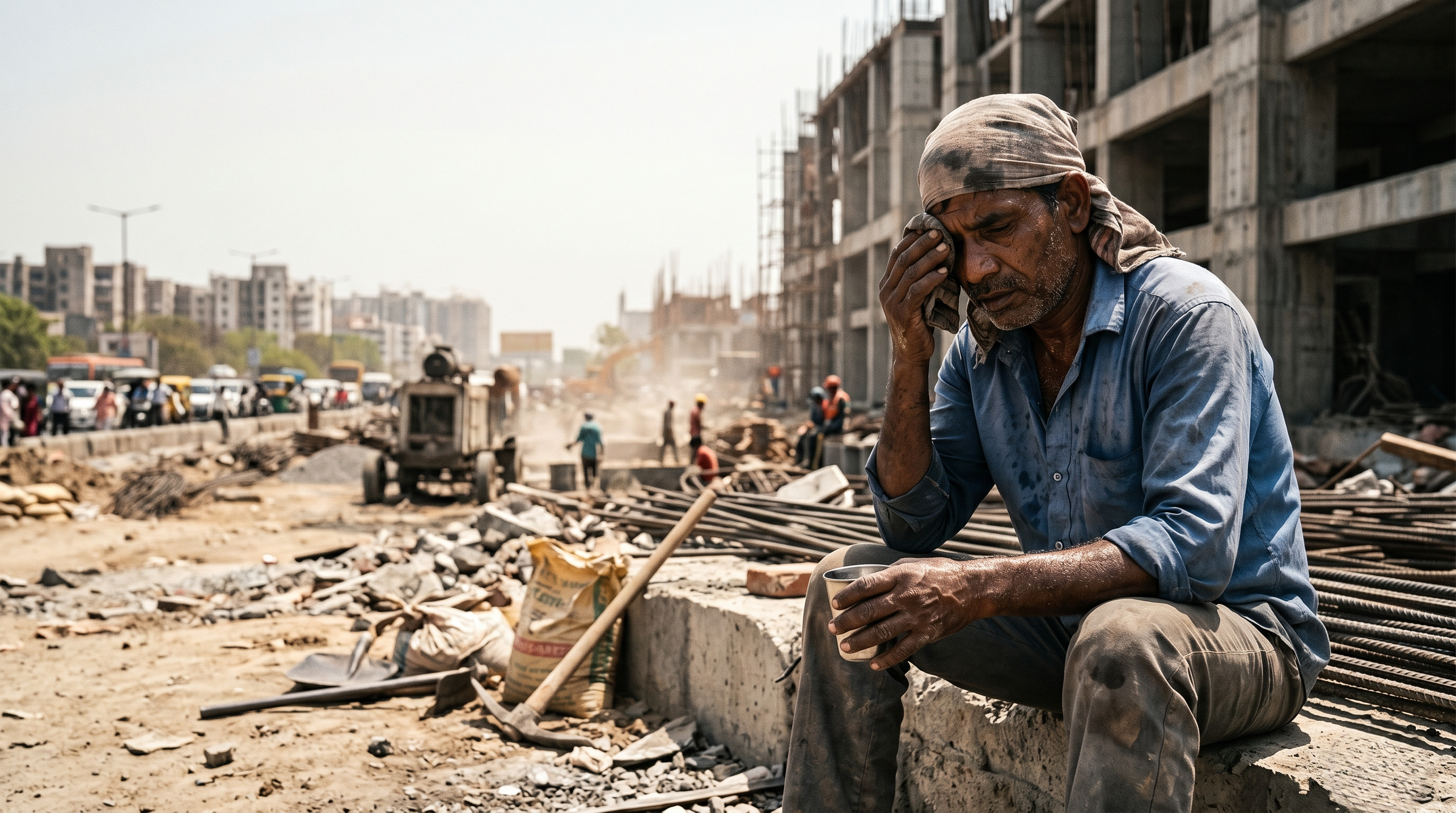
On the 29th of May 2024, Delhi recorded 49.9°C the highest temperature ever measured in the capital. The number trended on social media. Ministers issued advisories. Then the news cycle moved on. For Ramu, a 44-year-old rickshaw puller in West Delhi, the heat did not move on. Before that summer, he could work ten to twelve hours a day. By June, he was managing five. It had not slowed him down the way a traffic jam slows it had shut him down the way a power cut shuts down a factory. Physiologically, economically, completely.
Naresh, a street food vendor who has worked Delhi’s streets for two decades, described the same contraction: “Even under the scorching heat, we start at 6 AM. There’s no shade; inside our homes it’s hotter. People now prefer air conditioned restaurants. Business has fallen.” In Mumbai, Rajkumar Rao, 28, a cylinder delivery worker, told researchers that extreme summer had made it nearly impossible to complete his rounds by afternoon. As Geeta Thathra of the Work Fair and Free Foundation observed, workers like Rao continue under dangerous conditions “because of the lack of job opportunities and stagnant wages.” There is no financial margin for a day off. There is no sick pay. There is no shade that also comes with a salary.
These are not exceptional stories. They are the median experience of India’s 450 million informal workers over 90 percent of the total workforce who spend their working lives outdoors or in unventilated spaces, earning daily wages with no employment protection and no buffer between the temperature and their income.
India has 450 million informal workers. When the temperature rises, their earnings fall. When a heatwave lasts three weeks, three weeks of income are quietly erased. No insurance pays out. No employer compensates. No national statistic records it.
The heat tax, a regressive transfer imposed by a warming climate on those who did least to cause it2024: The Heatwave That Became a Baseline
India’s 2024 heatwave season was not a severe weather event in the conventional sense. It was a sustained and measurable assault on labour supply. The World Meteorological Organisation declared 2024 the warmest year on record globally, with mean temperatures exceeding 1.5°C above pre industrial levels. The India Meteorological Department recorded nearly 20 days of extreme heat exposure beginning earlier and ending later than previous years, reducing workers’ physiological recovery time between episodes.
Within the first 15 days of April 2024 alone, WRI India found that over 80 percent of India’s population was exposed to strong or very strong heat stress for more than six hours per day. The CEEW found that over half of India’s districts, home to 76 percent of the population, now face extreme heat risk. The National Centre for Disease Control recorded over 48,000 suspected heatstroke cases and more than 160 confirmed deaths figures that, as epidemiologists consistently note, represent a significant undercount, since heat rarely appears as a direct cause on death certificates and rural cases go largely unreported.
Labour hours erased by extreme heat exposure in a single year. Not projected. Not modelled. Recorded outcomes from seasons already passed and a preview of every season that follows. Equivalent to $194 billion in foregone income, 124 percent higher than the 1990s annual average. Agriculture absorbed 66 percent; construction 20 percent.
What makes heat analytically distinct from other climate risks is its mechanism of harm. A cyclone destroys physical assets homes, crops, infrastructure. The damage is visible, mappable, and insurable. It triggers formal disaster response and reconstruction spending. Heat destroys labour capacity. It is invisible in national accounts, absent from disaster declarations, and uncompensated in any policy framework. The economic loss of heat is diffuse, chronic, and borne silently by the individual worker who has no way to file a claim against the atmosphere.
Methodology: Estimates based on ILO labour force data × heat-affected hours by sector × temperature exceedance thresholds
One Degree Celsius. A Sixteen Percent Earnings Loss.
The relationship between temperature and worker earnings is no longer speculative. It is measured with econometric precision. A landmark 2024 study by Das and Somanathan, published in Environmental Research Letters, surveyed 396 informal workers in two North-West Delhi settlements during the peak heat months of May and June. The findings establish a clear quantitative link between temperature and labour income.
A single degree Celsius rise in mean temperature reduces net daily earnings by approximately 16 percent for informal workers. A comparable rise in wet-bulb temperature which captures the combined physiological effect of heat and humidity reduces earnings by 19 percent. During the two identified heatwave periods in the study window, workers’ earnings were 40 percent lower than on non-heatwave days.
Workers averaging ₹268 per day lost over ₹100 during heatwave episodes, while also reporting sleep disruption that compounded their physical inability to work the following day. The productivity loss mechanism is physiological before it is economic: as core body temperature rises, the body diverts blood flow from muscles to skin in an attempt to radiate heat, reducing physical work capacity and cognitive function below thresholds required for safe and effective labour.
ΔEarnings ≈ −0.19 × ΔTemp_wetbulb (°C)
Heatwave penalty: −0.40 (relative to non-heatwave days)
A 2025 study by Isaac and colleagues, based on 1,452 outdoor workers across agriculture, construction, brick kilns, fisheries, and salt pans, found that temperatures exceeding 32°C combined with humidity above 60 percent are physiologically hazardous a threshold that large portions of the Indo-Gangetic Plain now regularly breach. Wet-bulb temperature, which determines how effectively the human body can cool itself through sweating, is rising faster than dry bulb statistics suggest.
Methodology: Illustrative extrapolation from published regression coefficient (−16%/°C). Not a direct plot of observed data. For direction and magnitude indication only.
Climate Change Is a Discriminator,
Not an Equaliser
The framing of climate change as a universal threat affecting everyone regardless of income or position is politically convenient and analytically inaccurate. The same heatwave that allows a software engineer in Bengaluru to extend her work from home arrangement forces a construction worker in the same city to choose between standing in direct sun and losing his daily wage. The temperature outside is identical. The exposure, the protection, and the economic consequence are not.
India’s formal-informal divide is the fault line through which this inequality runs. Formal workers constituting less than 10 percent of the total workforce are largely insulated from heat-related income loss: air conditioned workplaces, paid leave, statutory health coverage, and employment contracts that guarantee income regardless of outdoor conditions. Informal workers have none of these protections. According to a CEEW report, only 30 percent of Indian households can afford an air conditioner or cooler. For a worker earning ₹300–400 per day, a ₹25,000–40,000 appliance represents two to three months of total income inaccessible by definition.
The gender dimension of this inequality is particularly severe. Women constitute 23 percent of employed persons in India’s informal sector, but 92 percent of employed Indian women work informally meaning virtually every woman in paid employment faces this risk without protection. A 2026 study of 115 garment workers in Tamil Nadu and Delhi found that 87 percent reported heat-related health symptoms in the previous 12 months none of which triggered formal compensation or work adjustment.
There is a structural irony in the cooling response that compounds this inequality further. Air conditioning increases electricity demand, which in India still largely means coal combustion, which increases the greenhouse gas emissions that make heatwaves more frequent and intense. The wealthy cool their offices and homes, generating emissions that heat the climate, which further disadvantages those who cannot afford to cool their own environments. This is not a policy failure in the narrow sense. It is a structural feedback loop embedded in the architecture of unequal energy access.
The GDP Measure Misses the Loss Entirely
India’s official economic statistics do not currently measure the economic losses caused by extreme heat. GDP accounts do not capture forgone informal earnings. The Periodic Labour Force Survey does not systematically record hours lost to weather. The Economic Survey mentions no heat-adjusted productivity measure. This is not a technical gap. It is a structural measurement failure with consequential policy implications: what is not measured cannot be compensated, prioritised, or managed. The Reserve Bank of India’s own 2024 report acknowledged that climate change poses “growing economic risks” to India’s growth a recognition significant enough to generate headlines, and insufficiently concrete to generate new measurement frameworks.
WRI India projects that by 2030, heat stress could cause a 6 percent fall in annual working hours and 34 million job losses, disproportionately concentrated in the informal sector. The Lancet Countdown’s estimate of $194 billion in income losses in 2024 approximately 5 percent of India’s GDP is not a tail risk. It is an annual event of growing magnitude. For individual gig workers, the arithmetic is viscerally immediate: Laddu, a 35-year-old Uber driver who spoke to Rest of World, described receiving only a quarter of his normal rides on extreme heat days. For a worker with no fixed salary, a 75 percent drop in order volume is not a difficult quarter. It is a household financial crisis.
Scenario: SSP2-4.5 (moderate warming) · 2025–2050 bars are scenario projections, not forecasts
The Distance Between Advisory and Law
The gap between India’s policy response and international practice is instructive. Qatar a country with summer temperatures regularly exceeding 45°C implemented mandatory outdoor work bans from 10 AM to 3:30 PM during June to September, with financial penalties for violations and mandatory provision of shaded rest areas, free water, and heat training. The ILO documented a more than 50 percent reduction in heat-related hospitalisations at compliant worksites following implementation.
The United States, under a 2025 OSHA proposal, is moving toward mandatory heat standards: shade and water requirements at 80°F, mandatory rest breaks at 90°F, wet-bulb globe temperature monitoring, and employer Heat Illness Prevention Plans. The EU’s occupational safety framework treats heat as a workplace hazard requiring employer management and inspections. Australia’s Safe Work guidelines mandate acclimatisation protocols and enforced work rest schedules.
India’s National Disaster Management Authority issued an advisory in 2024 asking employers to suspend mandatory outdoor work between 11 AM and 4 PM during heatwaves. The key word is advisory. It carries no legal force, no penalty clause, and no inspection mechanism. As The Wire reported in 2025, Manjar Alam a mason who fell fatally ill during a heatwave worked at a site that had received no heat warning, no protocol, and no protection. The formal legal recognition of heat risk and the operational infrastructure to respond to it remain in separate administrative architectures.
| Country | Policy instrument | Mandatory | Penalty mechanism |
|---|---|---|---|
| Qatar | 10AM–3:30PM work ban, June–September; WBGT >32.1°C: full cessation; shade, water, training mandated | Yes | Financial penalties for violations |
| USA (2025) | OSHA proposal: shade and water at 27°C; mandatory rest at 32°C; WBGT monitoring; employer prevention plans | Proposed | Fines and regulatory inspections |
| EU / Australia | Acclimatisation protocols, employer liability, work-rest schedules, state-level enforcement | Yes | Civil and regulatory liability |
| India | NDMA advisory: avoid work 11AM–4PM during declared heatwaves | Advisory only | None |
Recognition Without Enforcement Is Documentation of Neglect
India’s policy progress on heat is genuine but structurally insufficient. In 2024, the Ministry of Home Affairs made heatwaves eligible for funding under the State Disaster Risk Mitigation Fund a meaningful shift that places heat alongside floods and cyclones in the disaster financing architecture. As of 2026, 23 states are developing Heat Action Plans. Ahmedabad’s HAP has been cited by international researchers as a cost-effective adaptation model for reducing heat mortality in an Indian urban context. The CEEW Municipal Corporation initiative, committing ₹1 crore for cooling shelters in FY2025–26, reflects the right institutional instinct.
But these steps share a structural flaw: they are organised around mortality, not livelihoods. Heat Action Plans measure success as “zero deaths.” This frames heat as a health crisis rather than an economic one which means the income losses borne by 450 million workers who survive the heat but lose their earnings remain entirely outside the policy’s measurement framework. A worker who loses 40 percent of her income during a three week heatwave is a policy success because she is alive.
The deeper structural gap is the disconnection between India’s labour policy and its climate action framework. The Code on Social Security 2020 officially recognised gig, platform, and unorganised workers as a distinct category deserving of protection, and as of December 2025 over 31.38 crore workers are registered on the e-Shram portal. But registration has not translated into climate-linked income protection. There is no mechanism by which an IMD heatwave alert triggers an income support payment to registered workers in the affected district. The climate signal and the worker entitlement exist in separate administrative systems. Connecting them is not technically complex. It has not been politically prioritised.
Four Measures That Would Change the Calculus
When the IMD issues a red-level heatwave alert for a district, the 31.38 crore workers registered on e-Shram in that district should automatically receive a direct benefit transfer compensating for expected income loss modelled on the crop damage compensation that exists for farmers under PM Fasal Bima Yojana. The technical infrastructure for this mechanism already exists across DBT, Aadhaar, and the e-Shram registry. The missing element is a policy decision to connect the IMD weather signal to the worker’s entitlement.
Every city with a population above five lakh should be legally required to maintain a Heat Action Plan with dedicated municipal budget allocation and measurable implementation targets. The NDMA advisory on work suspension during peak hours must be converted into an enforceable regulation with penalties for employers who require outdoor work during red-alert periods. Qatar’s mandatory framework, introduced in 2021, reduced heat hospitalisations by more than 50 percent at compliant sites within a year of enforcement. India has the legislative capacity to achieve the same outcome.
The net-zero cooling stations launched in Jodhpur in 2024 combining wind towers, vetiver curtains, and misting fans provide cooling for up to 40 people without electricity at a fraction of the cost of conventional air conditioning. This is scalable at bus stands, construction sites, vegetable markets, and street vendor clusters. The Lancet Countdown estimates India’s 2022 fossil fuel subsidies at nearly $58 billion. Redirecting even a small fraction toward cool roofs, urban tree cover, and passive cooling infrastructure would yield measurable health, productivity, and equity dividends at a cost far below the income losses currently absorbed silently each summer.
The RBI acknowledged in its 2024 report that extreme heat poses growing economic risks. The productive next step is to operationalise that acknowledgement: the Economic Survey should publish an annual Heat Ledger district-wise estimates of labour hours lost, income foregone, and health costs attributable to extreme heat. SEWA’s parametric micro-insurance pilot, which disbursed nearly ₹5 crore to 50,000 women workers during the 2024 heat season based on temperature triggers, demonstrates that measurement can be connected to compensation. What gets measured gets managed. The inverse is equally true.
Parametric climate insurance for informal workers where workers pay a small seasonal premium and receive automatic payouts when district level temperature exceeds a defined threshold could bridge the gap between the climate signal and income protection without requiring case by case claims processing. SEWA’s pilot proved the concept works at small scale. e-Shram provides the delivery infrastructure at national scale. The World Bank’s Pandemic Emergency Financing Facility demonstrated that parametric triggers can disburse funds rapidly during crisis conditions. A Heat Emergency Financing Facility for informal workers trigger based, delivered through e-Shram, partially subsidised by international climate finance is the most direct application of existing institutions to a documented and growing emergency. It requires no new technology and no new bureaucracy. It requires only a policy decision to connect what already exists.
The heat does not choose its victims. The policy architecture has made that choice instead.
India’s 450 million informal workers did not design the energy system warming the atmosphere. India’s per-capita carbon footprint approximately 2 tonnes of CO₂ equivalent, against a global average of 4.7 tonnes makes this point plainly. Within India, the rickshaw puller and the construction worker and the garment stitcher contributed least of all. They consume almost no energy beyond what their bodies require for work and basic household function. And yet they bear the full incidence of climate change’s most immediate economic cost.
The $194 billion in income losses recorded in 2024 was not distributed across the income spectrum. It was concentrated almost entirely in the bottom 40 percent. It fell disproportionately on women, on lower caste workers who dominate outdoor occupations, on migrant labourers who lack the social networks to access relief, and on gig workers who have no employer to appeal to. This is not climate change as a universal phenomenon. It is climate change as an amplifier of existing structural inequalities extracting value from the most vulnerable and transferring it to no one.
WRI India projects 34 million job losses from heat stress by 2030. If India’s policy architecture continues to treat this as a health problem rather than an economic one counting deaths rather than livelihoods, issuing advisories rather than enforceable mandates, registering workers on databases that generate no income support those 34 million losses will arrive on schedule. They will not appear in GDP. They will not appear in press releases. They will appear, quietly, in the decisions families make about which meal to skip and which debt to defer.
“The heat does not care who you are. But India’s policy architecture has, through its silences and its advisories and its unmeasured losses, made a decision about who pays. It is always the person who cannot afford to stop working who has no shade, no savings, and no number in any statistic that the state currently tracks.”
Das, S., & Somanathan, E. (2024). Heat causes large earnings losses for informal-sector workers in India. Environmental Research Letters, 19(12), 124019. https://doi.org/10.1088/1748-9326/AD7DA4
Isaac, T., Ranjith, S., Latha, P. K., Shanmugam, R., & Venugopal, V. (2025). Physiological strain in outdoor workers: The hidden danger of high humidity. Environmental Research, 276, 121495. https://doi.org/10.1016/J.ENVRES.2025.121495
Lancet Countdown on Health and Climate Change (2025). India country profile. The Lancet. https://doi.org/10.1016/S0140-6736(25)01919-1
Council on Energy, Environment and Water (CEEW). (2024). Heatwave solutions for building resilience to extreme heat risks in Indian cities. http://www.ceew.in
World Resources Institute India. (2024). Prioritizing heat mitigation: A framework for India. wri-india.org
World Meteorological Organisation. (2025). State of the global climate 2024. WMO.
International Labour Organization. (2024). Heat at work: Implications for safety and health. ILO.
Reserve Bank of India. (2024). Climate change poses challenges for policy, risks to growth. Business Standard.
Think Global Health. (2024). The toll of extreme heat on India’s laborers. thinkglobalhealth.org
Dutta, S. (2025, June 4). Broken signals: India’s heatwave warnings are missing the mark. The Wire.
ETV Bharat. (2025). No shade, no shelter, no rights: Climate crisis is breaking the backs of India’s informal workers.
Rest of World. (2024). India’s heat wave makes it hard for gig workers to survive. restofworld.org
NRDC. (2024). Workplace heat protections across the globe. nrdc.org
Leave a Reply