India has more graduates than ever before. Yet many young degree holders struggle to find work. New labour market data reveals a surprising paradox about education and employment.

Part 1 — The Problem
Imagine Two Young People
Imagine two young people in India.
The first leaves school early after completing primary education and begins working. Perhaps they help on the family farm, work in a small shop, or join informal employment in their community.
The second spends many years studying. They complete school, attend university, and eventually earn a postgraduate degree.
Now consider a simple question:
Who is more likely to be unemployed?
Most people would instinctively answer: the person with less education.
After all, education is supposed to increase opportunities. The entire logic of modern education systems rests on that belief.
But when we examine India’s labour market data, the answer becomes far less obvious.
In fact, among young people, those with higher education often face higher unemployment rates.
In some cases, the difference is dramatic.
Young people with postgraduate degrees are many times more likely to be unemployed than those with only basic schooling.
This surprising pattern forms the central puzzle of this article.
The Data Behind the Puzzle
To explore this question, we analysed data from the Periodic Labour Force Survey (PLFS), conducted by India’s National Statistical Office (NSO).
PLFS is the most comprehensive labour market survey in the country. It collects detailed information from hundreds of thousands of households about employment, education, job search behaviour, and economic activity.
Because of its national coverage and large sample size, the survey is widely used by economists and policymakers to understand how India’s labour market is changing.
For this analysis, we focused specifically on young people aged 15–29, the group that is typically entering the labour market for the first time.
Our question was simple:
How does unemployment change as education levels rise?
The answer turned out to be far more interesting than expected.
The First Surprise
One might expect unemployment to steadily decline as education increases.
More education should mean more skills. And more skills should lead to better employment opportunities.
But the data shows something very different.

When we examine unemployment across education groups, a surprising pattern appears.
Among youth with primary education or less, unemployment is very low roughly 2 percent.
Among those with secondary education, unemployment rises slightly to about 3 percent.
Youth with diplomas show unemployment levels similar to those with basic schooling, around 2 percent.
But the pattern changes once we reach university degrees.
Among graduates, unemployment rises to about 4.5 percent.
And among postgraduate youth, the increase becomes dramatic.
Nearly one in five postgraduate youth about 18 percent are unemployed.
Instead of declining with education, unemployment actually rises at the highest levels of education.
This unexpected relationship is what we call the education–employment paradox.
Is This Only Happening to One Group?
Perhaps this pattern affects only certain groups.
Maybe it appears mainly among men. Or perhaps women face different labour market outcomes.
To investigate this, we compared unemployment rates across genders.

The results reveal another interesting pattern.
Overall unemployment among young men is higher than among young women.
In our data, around 7.9 percent of young men are unemployed, compared with about 3.4 percent of young women.
At first glance this may seem surprising. But the difference partly reflects labour force participation.
Many young women who are not working may also not report actively searching for work. In labour statistics, these individuals are classified as being outside the labour force rather than unemployed.
But the most important pattern remains the same.
For both men and women, unemployment increases as education rises.
Highly educated youth in both groups face much higher unemployment than those with lower levels of education.
What About Where People Live?
India’s labour market also varies significantly across geography.
Urban areas tend to offer more formal employment opportunities, while rural areas rely more heavily on agriculture and informal work.
So perhaps this paradox exists only in cities.

But the data suggests otherwise.
Both rural and urban areas show similar patterns.
While unemployment levels differ slightly between locations, the overall trend remains consistent:
higher education is associated with higher unemployment among youth.
This indicates that the paradox is not limited to specific regions or cities.
Instead, it appears to reflect broader structural features of India’s labour market.
The Paradox in One Picture
To better understand the scale of this phenomenon, we can compare unemployment risk relative to youth with minimal education.

The picture becomes clearer.
Young people with postgraduate degrees are many times more likely to be unemployed than those with only basic schooling.
This does not mean education has no value. Education still improves many aspects of life, including long-term earnings and opportunities.
But when young people first enter the labour market, the transition from education to employment appears to be much more difficult for those with higher degrees.
This is the paradox we set out to understand.
The Big Questions
These findings raise several important questions.
- Why does unemployment increase with education?
- Why are graduates struggling to find work?
- Is the economy failing to create enough skilled jobs?
- Are educated youth unwilling to accept informal work?
- Is there a mismatch between education and labour market demand?
Answering these questions requires looking beyond the numbers and understanding how India’s labour market actually functions.
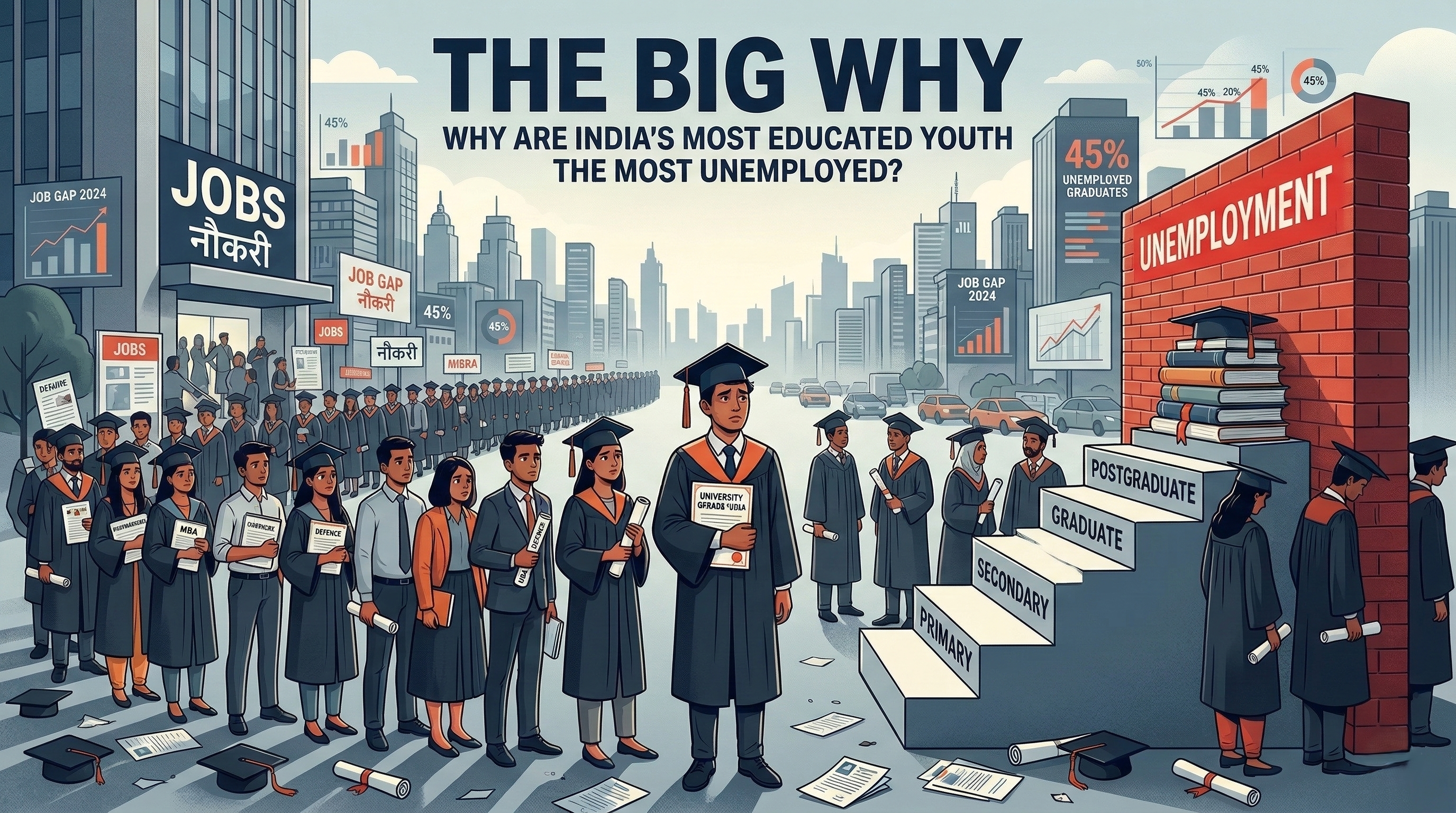
The Big Why
The data reveals the paradox.
But it does not yet explain it.
Understanding why highly educated youth face higher unemployment requires examining deeper economic forces, from the structure of job creation to expectations about work, skills, and the changing nature of India’s economy.
In Part 2, we explore the deeper forces behind this paradox.
Because sometimes the most interesting answers begin with a simple question:
Why?
Note: This analysis is based on the Periodic Labour Force Survey (PLFS) 2023–24 conducted by the National Statistical Office (NSO), Government of India. Results are calculated using survey weights and focus on youth aged 15–29.
Leave a Reply